Heirloom Market Exhibit·Dog Oil Paintings

ANTIQUE DOG PORTRAITS.

The old market for beloved dogs, inherited houses, and painted memory.

Antique dog portraits occupy a small but enduring corner of the art market.

They are not bought only because they are decorative. They are bought because they hold a very particular kind of feeling: the household animal treated with the seriousness of a formal sitter.

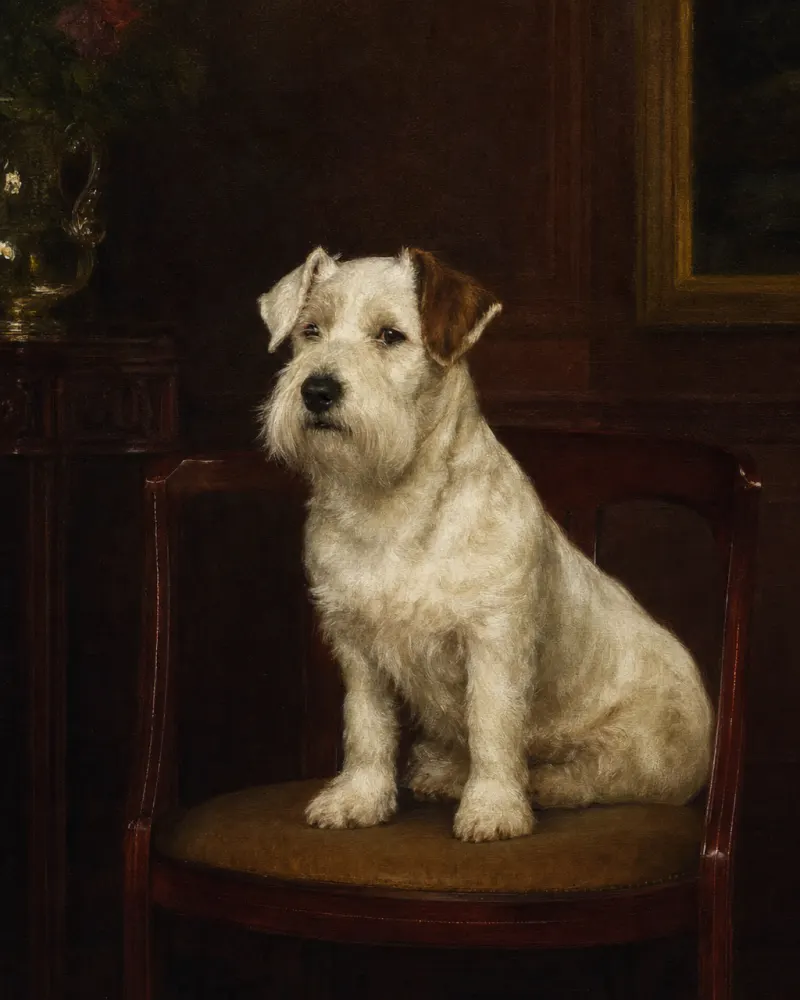
A spaniel on a cushion. A hound in a field. A terrier beside a chair. A mourning dog near the belongings of his master.

These portraits often began as private commissions. A family, patron, sportsman, or breeder wanted a particular dog remembered in paint. The result, a century or more later, is an object with two histories. The history of the dog. And the history of the house that kept him.

That is why antique dog portraits remain collectible. They are intimate, but formal. Emotional, but composed. Personal, but old enough to have become part of the market.

§ I

What Counts as an Antique Dog Portrait?

In the art and collecting world, an antique dog portrait usually means an original work that is at least 100 years old.

An antique dog portrait is not simply a new image made to look old. It is an object that has survived time: canvas, paper, panel, provenance, wear, repairs, and ownership history.

Collectors generally look at four properties when evaluating a piece:

  1. Age — at least 100 years old
  2. Originality — original canvas, board, or paper; not a 20th-century reproduction
  3. Provenance — documented ownership history, ideally back to the original commissioning patron
  4. Recognized hand — attributed to a known painter, or at minimum to a recognized school

A named painter raises the value significantly. So can a desirable breed, a documented sitter, an old estate connection, or a painting that clearly belongs to the high period of British or European dog portraiture.
§ II

The Victorian High Point

Most antique dog portraits in active circulation today come from the nineteenth century — and especially from Britain.

Sir Edwin Landseer (1802-1873) is the apex. Queen Victoria's favored painter for animal subjects. Landseer canvases that come to auction now sell, depending on size and subject, between roughly $80,000 and $1,000,000+.

Maud Earl (1864-1943) painted the dogs of King Edward VII. Earl works regularly sell in the $30,000-$120,000 range.

John Emms (1844-1912) specialized in foxhounds, terriers, and working dogs at rest in stable interiors. Emms canvases typically sell in the $15,000-$60,000 range.

Sir Alfred Munnings (1878-1959) carried the sporting tradition into the early 20th century. Munnings dog works often sell in the $20,000-$200,000+ range.

On this site, we treat these painters as part of art history. They are not used as a claim about our own work. They are the historical context that explains why antique dog portraits still matter. For longer biographies, see vintagedogoilpainting.com.

§ III

The Auction Market Today

Sotheby's19th & 20th Century European Art sales in London and New York regularly include dog portraits.

Christie's — similar coverage; Old Master & British Paintings and 19th Century European Art sales.

Below the major houses, the next tier is regional auction houses (Bonhams, Skinner, Doyle) and specialist dealers, where dog portraits sell more often in the $3,000-$25,000 range.

The third tier is high-end resale platforms — 1stdibs, Invaluable, Live Auctioneers — where dog portraits from the late 19th century into mid-20th century by minor painters sell in the $1,500-$8,000 range.

Collectors often read these works through several lenses: breed, painter, period, condition, and emotional presence. That last one is harder to catalogue, but often decisive.

§ IV

Why Antique Dog Portraits Feel Different

Many animal paintings are admired for beauty, motion, or decorative effect. Dog portraits ask for a different response. The viewer instinctively looks for personality.

Even when we do not know the animal's name, we sense that someone did.

Over time, the personal story may disappear. The painting remains. And the viewer supplies the feeling. This is the strange power of the antique dog portrait: it is both anonymous and deeply personal.

§ V

The Modern Alternative

For most buyers, the antique dog portrait market is not especially accessible. The best works can be expensive. And there is one obvious limit:

You cannot commission an antique. You can only buy one that already exists.

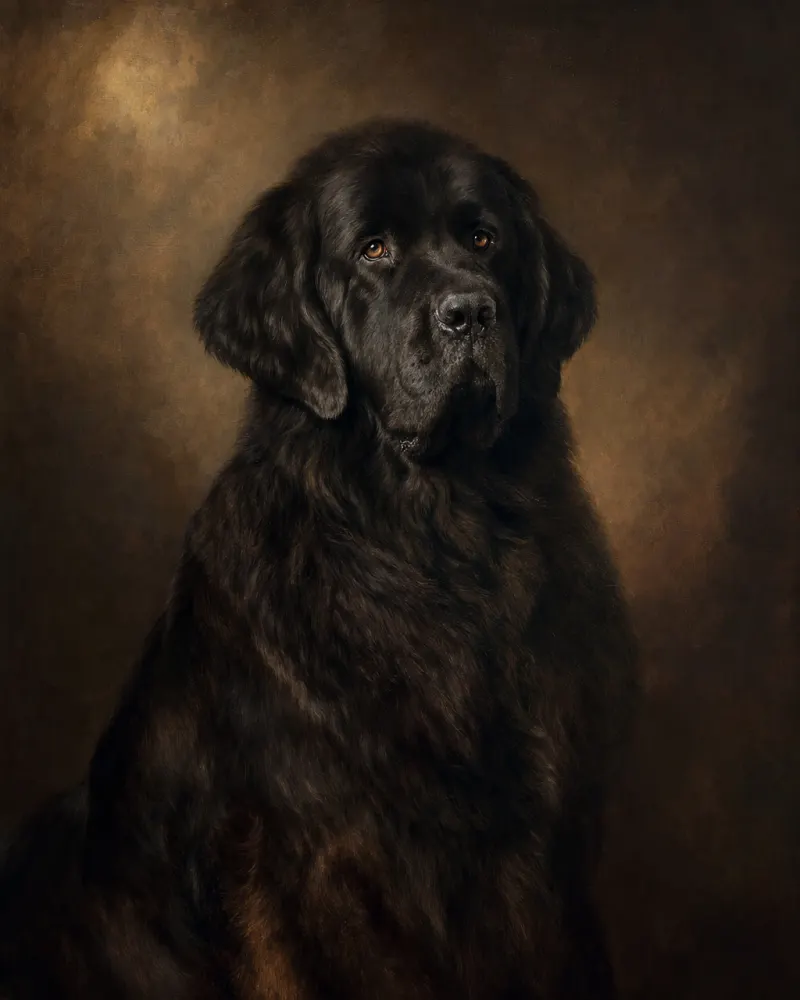
The modern alternative is a contemporary dog portrait in the classical oil register — a new commission made with old portrait conventions in mind: composed light, formal posture, quiet background, and a sense that the dog deserves to be treated as the central subject.

At Dog Oil Paintings, the process begins with your photograph. The portrait is AI-rendered, then hand-reviewed by Mercy before it ships. The print is produced on archival Hahnemühle Fine Art paper — a German mill founded in 1584 — configured with 22 frame collections, 28 mat colors, and 4 glazing options.

The result is not antique. It is not sold as antique. It is not described as hand-painted. It is a modern commission made for the same reason antique dog portraits were once commissioned: someone wanted a particular dog remembered well.

§ VI

A Note on Language

Because antique dog portraits are a historical category, we use the phrase carefully.

An antique dog portrait is an old original work — at least 100 years old, with provenance and recognized attribution.

A modern commission is not antique. It may draw from the classical oil tradition, but it belongs to the present. It is made from a contemporary photograph, rendered through a modern process, and reviewed by a real person before it ships.

That distinction matters. It protects the buyer. It protects the work. And it lets the portrait stand honestly on its own terms.

Commission the Modern Equivalent

In the register that has carried serious dog subjects for two centuries.

You cannot commission an antique dog portrait. But you can commission a portrait of your own dog in the classical oil register — composed with the restraint, warmth, and seriousness that made the older tradition endure.

Common Questions

Plainly answered.

How does the studio's modern commission compare to an antique?
The modern commission is not antique and does not present as one. What it shares with antique dog portraits is the visual register — the warm palette, the directional light, the dark studio ground, the painterly oil-on-canvas surface — and the substrate quality (archival Hahnemühle Fine Art paper). What it does not share is age, provenance, or the named-hand attribution that drives the auction market.
Do you sell antique dog portraits?
No. Dog Oil Paintings does not sell antique portraits. This page discusses antique dog portraits as an art-history and collecting category. The studio offers modern dog portrait commissions in the classical oil register.
Can I commission an antique dog portrait?
No. An antique already exists by definition. What you can commission is a modern dog portrait that uses classical portrait conventions — composed light, formal posture, quiet background, and a painterly oil-register finish.
How much do antique dog portraits cost at auction?
Heavily painter-dependent. A signed Landseer can bring six figures or higher; a good Maud Earl spaniel sits in the mid-five-figure range; a John Emms hound around $15,000-$60,000. Below the major houses, anonymous late-19th-century works sell at $1,500-$8,000 on resale platforms.
Are your portraits hand-painted?
No. Pet Pic Portraits creates AI-rendered portraits that are hand-reviewed by Mercy before they ship. The process is disclosed clearly on the site.